2026 marks the twentieth anniversary of Artist’s Resale Right (ARR) in the UK, a significant milestone and an opportunity to reflect on two decades of commitment to ensuring fairness for artists.
More than 20,000 UK-based artists campaigned for ARR since 1993, working closely with counterparts in Ireland and the Netherlands and engaging with MPs, MEPs, and EU and UK government officials. On the other side, art market professionals strongly opposed ARR, fearing that it would cause the British art market to decline in favour of the United States or China, where ARR does not exist.
ARR was formally introduced in the UK in 2006 through the Artist’s Resale Right Regulations, five years after the adoption of the European Resale Rights Directive. The European Union introduced the Directive to harmonise ARR across Member States, and to strengthen protection and rights for authors.
Initially, the right applied only to living artists. In 2012, it was extended to the estates of deceased artists for the remainder of the 70-year copyright term. Despite early criticism, the UK art market continued to grow, and the UK became one of the world’s largest art market, and the first collector – and distributor – of ARR royalties.
Since 2006, the Design and Artists Copyright Society (DACS) collected £144 million that have been distributed to 7,000 artists and their heirs. £9.2 million were distributed in 2025 alone.
It is worth noting that 60% of distributions go to emerging and mid-career artists, with individual payments under £500. This highlights how ARR directly supports artistic creation and particularly younger artists, for whom every source of income can make a meaningful difference.
To learn more about ARR in the UK, visit DACS’ dedicated article.
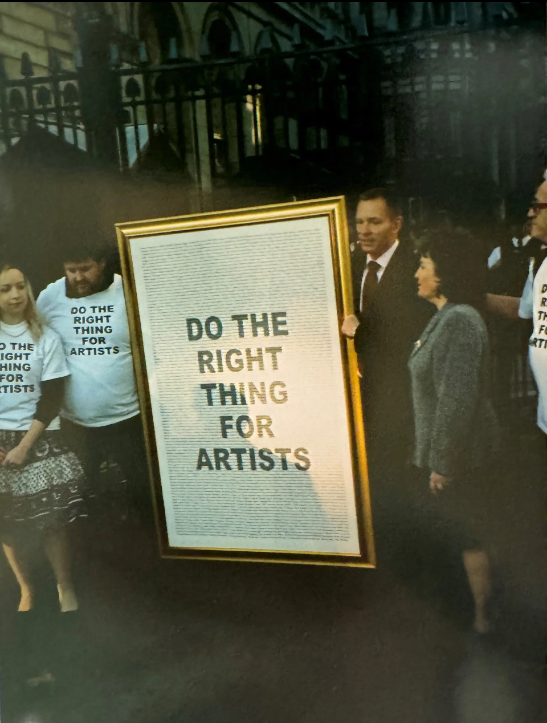
Image: Artists and Sir Chris Bryant MP outside the Royal Courts of Justice © DACS 2005